
pryshliak - Суперх'юманс Центр - Page 3

Mental trauma in a warzone: Why Ukraine needs therapists

During the Soviet era, many of Ukraine’s political dissidents were locked up in asylums.
It’s why mental healthcare carries a negative stigma.

But as the war with Russia rages on, Ukrainians are learning they need therapy to build the resilience of the nation.

Millions of Ukrainians require psychosocial support, and the number is only rising. From soldiers injured in battle to communities displaced by the invasion, the strain on mental health systems is immense in this humanitarian crisis.

Mindset meets Ukrainian therapists and their patients in the midst of one of the biggest mental health crises in living memory.

After facing death, injured Ukrainian soldiers relearn intimacy

KYIV — The two Russian Lancet drones hovered briefly over a small house-turned-military base in northeast Ukraine, then exploded. Inside, shrapnel pierced through the pelvis and thigh of a Ukrainian combat medic who goes by the call sign Alaska.
As the house burned and she was evacuated to safety, Alaska texted her boyfriend, who is in a different Ukrainian unit, using the military code for wounded: “I’m 300.”
That short message marked the start of a new chapter in their emotional — and physical — relationship, an experience now confronting many couples in Ukraine. Tens of thousands of Ukrainians have been severely wounded since Russia invaded in early 2022. Many soldiers return from the front in wheelchairs or needing prostheses. Often, the injuries — including amputations, facial damage and severe concussions — are life-altering.
Publicly, wounded soldiers are often hailed as heroes. In private, they must navigate the complicated ways their injuries have changed their bodies, minds and love lives.

“I was in constant pain, on medication, and was vomiting after my concussion, so I wasn’t happy to be next to anyone or happy to see anyone, including him,” Alaska, 30, said of her partner. It was weeks after she was wounded before he could leave his position to visit her and when he did, his presence did not always bring the joy she expected. “We had these moments when I wanted to break up,” she recalled. “The level of pain was so bad I even wanted to die by suicide.”
Olga Rudneva, CEO of Superhumans, a rehabilitation center in western Ukraine, said government data from July showed that 20,000 people — civilians and soldiers — had lost at least one limb since February 2022. The nature of the grinding artillery conflict means other injuries are also widespread, including burns and shrapnel and bullet wounds.
Alaska’s partner stuck with her, and after four months, they were intimate again for the first time since she was wounded. Almost a year later, she has redeployed to a position further from the front line because she is still in severe pain and relies on a cane to walk. A fellow soldier helped their relationship recovery by sharing a guide from Resex, an initiative from Veteran Hub, a Kyiv-based nonprofit that developed handbooks for soldiers on how to manage their sex lives after severe physical and emotional trauma, she said.

The books — with versions for men and women — use simple text and drawings to describe how sex organs work and how injuries might alter someone’s sexual experience. Medications like opioids may reduce libido, it warns, and for amputees, phantom pain might deter intimacy. “It can be painful from the very beginning because simple movement with amputation might cause severe pain and that leads to turn-off,” the book says.

The books suggest fostering closeness with partners through massages or by dancing and cooking together. If talking feels uncomfortable, it says, try writing a note to express “feelings and fantasies” and placing it somewhere your partner might find it, like in their bag or pocket.

Any wounds should be “healed properly” before engaging in sex, the handbooks advise. Otherwise, a partner could touch the wound by accident or behave too cautiously out of fear of causing pain.
Even so, many people decide not to wait.
After a long-range artillery attack struck his base last year, doctors gave Serhii Kopyshchyk a 20 percent chance of survival. Severe wounds to both legs required a double amputation. He was blinded in one eye and shrapnel had ripped through his stomach and lungs.
But just weeks later, when his girlfriend Svitlana visited him, they had sex in the shower in his hospital room. “His belly was injured, he had no legs, but we’re a young couple,” she said with a laugh.

Yevhen Tiurin, 30, was single when a Russian soldier shot him in the leg during a gun battle in a wheat field in April 2022. The bullet first struck his calf, then ricocheted internally, lodging itself in his hip. By early May, doctors decided to amputate his right leg above his knee.
At the hospital where he was recovering in Lviv, a nurse caught his eye. “Prosthetics are really cool right now,” she told him. “You’re going to walk on two legs.”
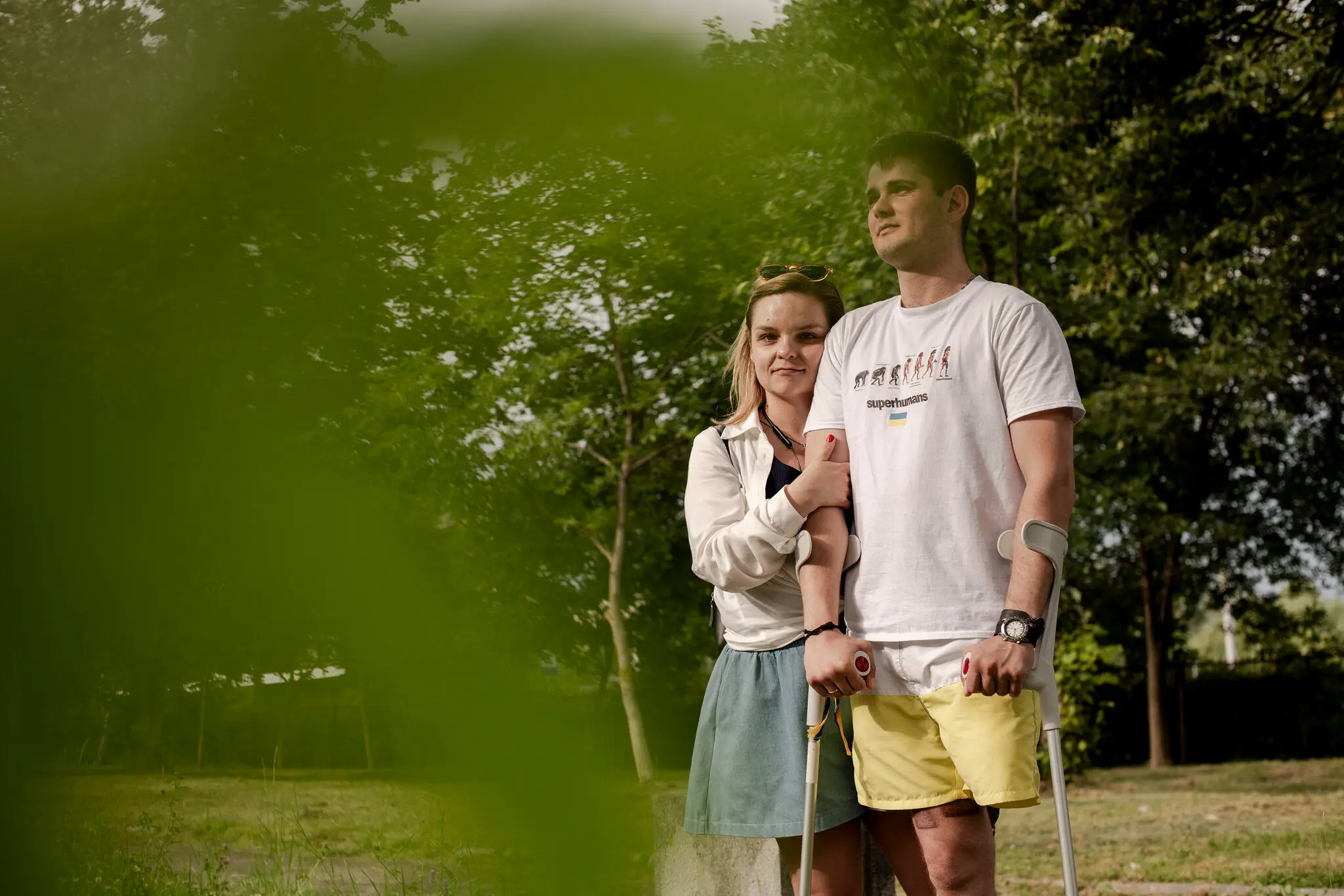
From his hospital bed, a romance bloomed. They texted regularly. She visited him between shifts. Eventually, he proposed and — together — they learned what his body could and could not do. He felt some shame, he said, that when they were first dating, basic gestures — like carrying bags — that would have been a given before his injury were no longer possible.

He didn’t want his discomfort to affect their sex life. “When we started to make love I researched two or three positions I was sure I’d be able to do,” he said. As more time passes after an injury, he said, “the more you find positions that work for you.”
In August, their daughter, Mariya, was born. It helped, he said, that his wife is a nurse “who was next to me through the whole [recovery] process.”
Even in hospitals with other young, wounded soldiers, there was very little discussion of how their injuries would affect their sex lives, Tiurin said. Only one other soldier asked him for advice about sex positions, he said, but he wasn’t sure how helpful he could be: that man was also missing an arm.
There was no resource like Resex in 2015, when an enemy bullet ricocheted off Rodion Trystan’s rifle during a gunfight in eastern Ukraine, piercing his skull. He lost an eye and shrapnel damaged his brain and frontal skull bone. His heart briefly stopped but he was revived and fell into a coma.

With his missing eye and altered bone structure, he noticed how others treated him with respect when he was in uniform and alarm when in civilian clothes. “I was very nervous about my new face,” he said. When he tried dating again, some women admitted they were scared of his scars.
Rudneva, from Superhumans, said that in her experience, patients with facial injuries feel much more acute stress than those with limb amputations. Many “don’t leave their apartment because they are so scared of the way they look and so depressed by the fact they lost their identity,” she said.
With time and therapy, Trystan said, he learned to “accept rejection even when it’s rude.” Even when he became confident with his new appearance, he realized “it will not help in every case.”

“The game has changed, you have changed,” he said. “Don’t make a big deal about what other people think about you.”
But not everyone finds ways to adjust to their new reality.
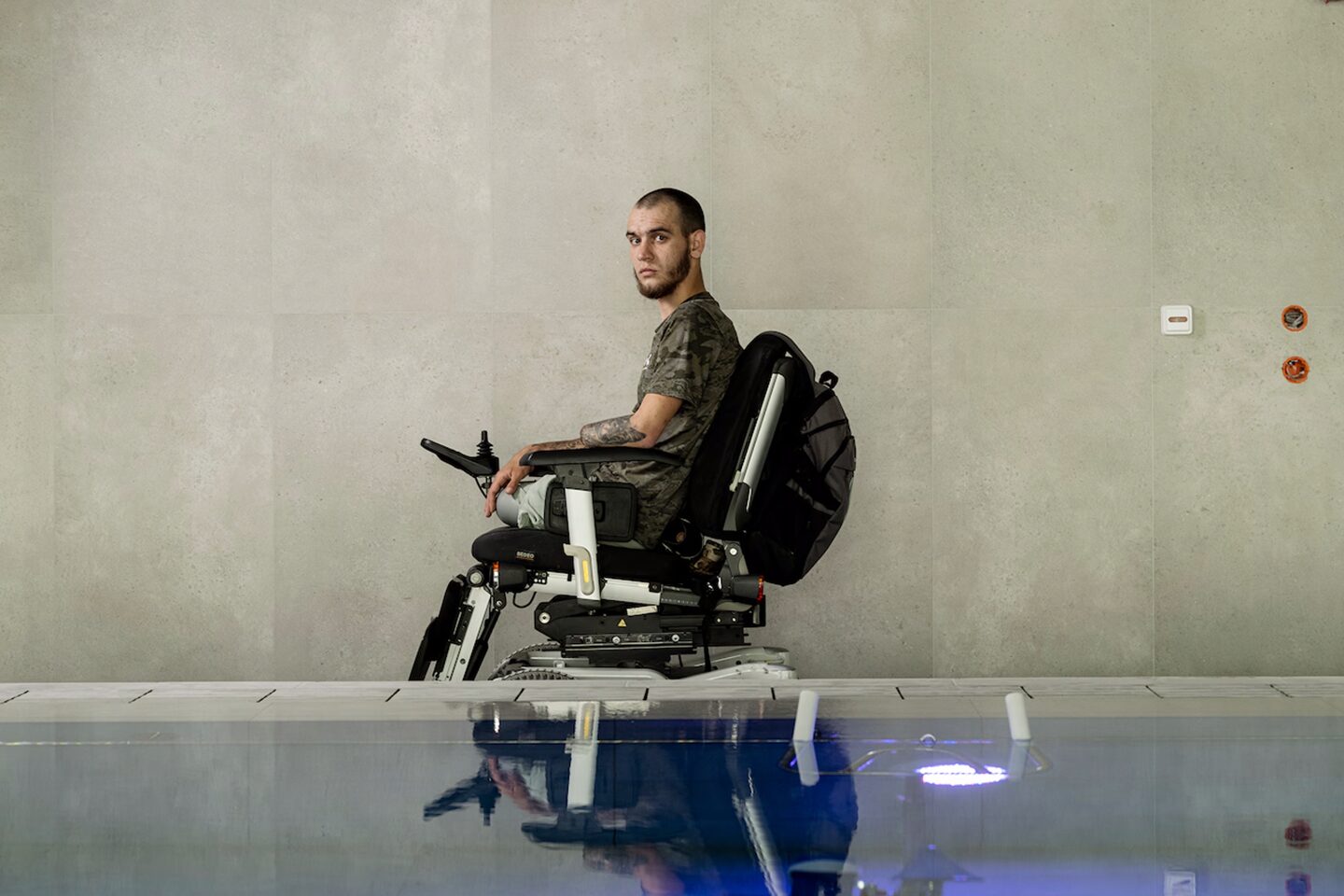
Dmytro Pavlov, 31, was a welding engineer in the eastern city of Kramatorsk before Russia attacked last February, spurring him to join his local territorial defense unit. Then, two days before his 30th birthday, he was shot in the back of the leg.

Single and having recently come out as gay to his unsupportive parents, he sunk into a deep loneliness in his hospital room hundreds of miles away in western Ukraine. Online, he sought support from the LGBTQ+ community and joined a Telegram channel for other gay troops, which helped him connect to his first sex partner after the injury.
But now, more than a year later and after seven surgeries, he still has no feeling in his foot. He struggles to walk and quit a job at a cafe because he couldn’t stay on his feet for the shifts, spurring fears he will not be able to pursue his longtime dream of becoming a pastry chef. He knows other wounded soldiers are successfully dating. But his romantic life is bleak, he said.

He tries to be upfront about his leg in his online dating profile, but when he mentions his war injury, he said “some people are just blocking me.” On the street, he said, “people look at me with this sorrow.”
Those who already have a supportive partner before being wounded often have a different experience.

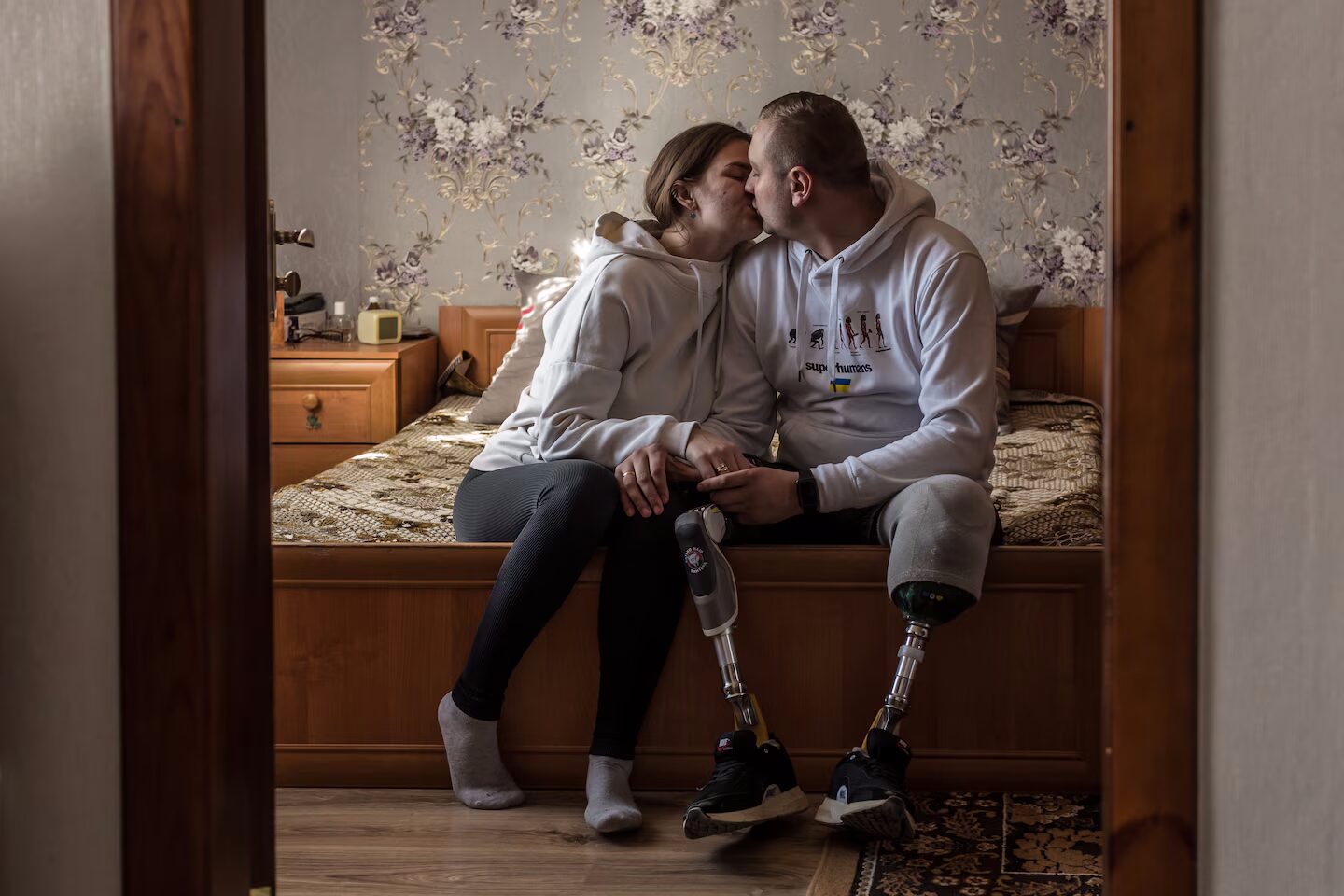
For Kopyshchyk, who is now 25, it was a relief after losing both his legs and half his sight that he could still have intercourse. His relationship with Svitlana was new — based off a brief romance before the invasion and then hours of phone calls from his mortar position near Kherson. But the long calls — and then his injuries — bonded them, and the couple soon married.

When Svitlana learned she was pregnant, Kopyshchyk was determined to hold his child on two feet. He was treated at Superhumans, where he learned to walk on his prostheses just in time for his son’s birth.
Before his new legs, he said, sex was easiest for him from his wheelchair. Now, once Svitlana is recovered from birth, they will explore what role his legs might play in their sex life. “Even more will be possible,” he said.
On a recent morning, they sat on the edge of their bed, taking turns holding their son. She curled her toes around his prosthetic leg as they described how phone calls helped them stay connected to each other’s worlds when he was on the front line.
When he asked her over the phone just two weeks before he was wounded if she would be his girlfriend, he also asked: “Are you ready if something might happen to me?”
He still remembers her reply: “At least then you’ll have something to return to.”
And he did.

They’re Ready to Fight Again, on Artificial Legs

LVIV, Ukraine — The Superhumans Center is full of war amputees learning to walk on artificial limbs or smoking cigarettes clutched in prosthetic fingers.

Yet this philanthropically supported hospital for wounded Ukrainians is not antiseptically depressing, as hospitals often are. Perhaps that’s because of the admiration that Ukrainians feel for these veterans, leading them to carry their stumps with pride — and to plan a return to the front with artificial arms and legs.

“I do not see disabled people,” Oleksandra Kabanova said as she sat waiting for her husband, Oleh Spodin, to complete a physical therapy session. “I see superheroes.”

She eagerly shared the story of how Spodin lost his leg: He volunteered to go out and rescue a wounded comrade. “He’s very sexy without a leg,” she added, beaming.

That’s where I think Vladimir Putin miscalculated when he invaded Ukraine last year: He underappreciated Ukrainian grit and resilience. I suspect some Americans make the same mistake. Month after month, Ukrainians have lost buildings, heat, electricity, lives — yet they are ready to keep sacrificing, and there is a society-wide reverence for those who have given so much.

A recent poll found that 78 percent of Ukrainians had close relatives or friends killed or injured in the fighting. That’s a staggering toll, yet if anything, it has strengthened Ukrainian determination rather than weakened it. On each of my visits to wartime Ukraine, what has struck me the most is not the immense suffering but the even more overwhelming resolve to win.

While the pain and difficulty faced by those struggling to learn to walk again are enormous, the public adulation is a salve.

“This week, a woman tried to embrace me at a bus stop,” said Denys Kryvenko, 24, who lost both legs and an arm in January in fighting near Bakhmut. “People have tried to give me food, give me money, give me hugs.”

Kryvenko told me that even as a triple amputee, he is going to rejoin his unit on the front line.

“My unit is waiting for me,” he insisted. He is discussing two roles: either as an instructor for paramedics — he is proof of the value of tourniquets, three of which saved his life — or as a counselor to coach soldiers struggling in bleak times.

Bohdan Petrenko, 21, whom I met when he was practicing walking with his artificial leg, is likewise planning to rejoin his military unit as soon as he fully recovers from the mortar injuries that took his leg and mangled his arms. Petrenko said he would return to the front as a radio man or drone operator.

Petrenko had a crush on a girl in his hometown before the war but had never dared ask her out, and when fighting broke out she evacuated to Poland. On a trip back to Ukraine to visit her parents, she heard he was injured and when passing through Lviv stopped by to visit him in the hospital.

“She never left,” he added. “She’s still here. It’s magical.”

They’re now living together, he said, adding, “Someone can have all his arms and legs and still not be successful in love, but an amputee can win a heart.”

The West should surely do a better job providing Ukraine with the F-16s, tanks and long-range missiles it needs to end this war. But what may matter even more than weaponry is the value of the Ukrainian determination to win — even on prosthetic legs.

The war amputees are stoical about their challenges, for they’ve lost friends and, by that standard, feel fortunate. “After the amputation, I didn’t feel so bad,” mused Yevhen Tiurin, 30, with a grin. “The problems in my leg were now over.”

The nurse treating him, Olha Baranych, was impressed. “Something clicked in my heart,” she recalled. They married and are expecting their first child in August.

Kabanova, the woman who thinks her husband looks sexy without a leg, acknowledges that heroes aren’t always family-friendly. Being alone while Spodin was on the front was “10 months of hell,” she said. When he was injured the first two times, she begged him to come home to her.

Spodin refused. Then on Feb. 15, he called Kabanova and sounded different, weak.

“Are you injured?” she asked.

“My leg is missing,” he said faintly but, trying to maintain his humor, added, “A piece of me will stay behind forever.”

Kabanova becomes teary at the recollection. “People thought that girls would dump guys after their injuries,” she said fiercely. “No way! It doesn’t work that way.”

Spodin’s amputation was imperfect, so he had to undergo another surgery to reshape the stump, and now he’s waiting for the wound to heal so that he can get a prosthetic limb — and then he’ll be back to war.

“Amputation is a temporary difficulty,” Spodin explained. “These are just new conditions in our lives that we must adjust to.”

Author: NICHOLAS KRISTOF

With Russia claiming Bakhmut, Ukraine tallies cost in lost lives and limbs

LVIV, Ukraine — A Buddhist chef was sent to Bakhmut to cook for soldiers on the front line and ended up joining the men in the trenches instead, losing nearly all his hearing when a drone crashed into his chest.
A 24-year-old foundry worker turned soldier lost both of his legs and an arm when Russian shelling landed by his feet. A 28-year-old IT worker lasted less than two weeks defending the city before a rocket blasted off the lower part of his left leg.
They are among the soldiers who fought in Bakhmut — and are now living with the cost of the war’s bloodiest battle.
They arrived in the eastern city — some with limited training — and faced off against a ferocious army of Russian mercenaries and soldiers. They left with life-altering injuries.
And in recent weeks, they watched Russian forces declare victory and claim control of the ruined city — if only momentarily. In a new counteroffensive, Ukrainian troops are already pushing to take it back.

Ukraine does not publish running casualty numbers. But thousands were killed, and many more suffered permanent injuries, fighting for Bakhmut, even as analysts repeatedly said it held no strategic value. Over months, U.S. officials advised Ukraine to abandon the city. But Ukraine persisted in its defense, turning the city into a rallying cry: “Bakhmut holds!”
Five soldiers wounded in Bakhmut spoke to The Washington Post in rehabilitation clinics and hospitals in the western city of Lviv. They said the sacrifice was necessary.
Here are their stories.

Volodymyr Boyko was less than half a mile from the Russians on Aug. 10, when a blast near him sent shrapnel flying into both of his legs. A soldier next to him died instantly when a shell hit him in the head. Boyko, whose call sign is “Baby,” doesn’t remember exactly what caused the explosion. He just remembers his ankle dangling off the rest of his leg.
The lower part of his leg was amputated. He spent three months in bed recovering from shrapnel injuries in his backside. It would take more than nine months for him to begin to learn to walk again with a prosthetic leg.

He watched from afar as the battle intensified after he left.
“It was a meat grinder for both sides,” he said. “Frankly speaking, at some point we were fighting for what, ruins? There was no city left.”
The destruction of the city represents “a huge loss to Ukraine.” But he says the decision to hold Bakhmut was a tactical one.
“I think it was important to keep them where we could stop them,” he said.

Before the war, Ivan Garin was known for helping open some of the first prominent Japanese restaurants in Ukraine. As a Buddhist, he lived by the belief that it was wrong to harm another person.
Then Russian troops invaded his country, and he was sent to Bakhmut as a chef, cooking borscht for soldiers. But as his unit lost more and more men his commanders asked if he could join the trenches. He agreed.
“I wasn’t trained enough for such battles,” said Garin, whose call sign was “Cook.” “There are some soldiers with an eagerness to fight. I’m not one of those. But I understood that I had to go, I had to fight.”

Russian corpses littered the trenches his unit captured; the smell so nauseating that he couldn’t eat for days. Then, on May 17, a drone barreled straight into his chest. His bulletproof vest saved him, but the blast knocked off his headphones. He lost consciousness for five minutes. When he woke up, he couldn’t hear.
Two weeks later, only 20 percent of his hearing had returned — and only in his right ear. During the day, he hears cicadas ringing; at night, all he hears is the buzz of the approaching drone.
When he thinks back on the battle for Bakhmut, he still chooses to believe it served a purpose.
“Our mission was to hold Russia … to give a chance to new brigades,” he said. “It had to have happened for some reason.”

Denys Kryvenko, a freckled 24-year-old former foundry worker, knew what was waiting for him when he was transferred to Bakhmut. A friend had been on the city’s front line already. His main advice: “Start digging trenches immediately. Your life will depend on it.”
On Jan. 3, his unit was told to pull out of their position in a village nearby. As they retreated, a shell fell just in front of him. He looked down and saw that his hand was gone. He was missing one leg, and the other was badly mangled. Two soldiers helped search for his leg and arm, but Kryvenko shouted to them: “Just get me out of here!” The men carried him for more than a mile under Russian shelling.

Doctors told his mother that there was a 50 percent chance he would not survive surgery. He now has prosthetics for his legs and arm.
He refuses to believe that the Russians are in control of Bakhmut. He’s still in touch with Ukrainian soldiers near the city and believes they continue fighting.
“The only thing I’m really sorry about is all the men we’ve lost,” he said.

Dmytro Ustymenko, who had worked in IT before the war, knew the battle for Bakhmut would be the fiercest in the war. The shelling was constant, and the soldiers had no time for breaks. “You’re fighting and smoking at the same time,” he said.
Less than 12 hours after his platoon arrived at their position just north of Bakhmut, two of its men were killed.
At one point, when the Russians tried to capture a small village outside Bakhmut, Ustymenko found himself in gun battles with Russian mercenaries over control of a single house — fighting from across a bedroom.

When a new rotation of soldiers finally arrived, Ustymenko — whose call sign was “Fox” — was showing them their positions and moving to a bunker close by when a Russian rocket exploded just a foot away from his leg. After a grueling operation, he hopes to get fitted for a prosthetic leg.
While he knows it is unlikely, he hopes to rejoin his unit — perhaps to continue fighting for Bakhmut.

As a platoon commander, Bohdan Yatsun knew his unit’s morale depended on him. To motivate his soldiers, he reminded them of their mission.
“While we have this very intense fight in Bakhmut,” he would tell them, “we are giving a chance to other forces to focus in other directions,” to train and prepare for the counter offensive.
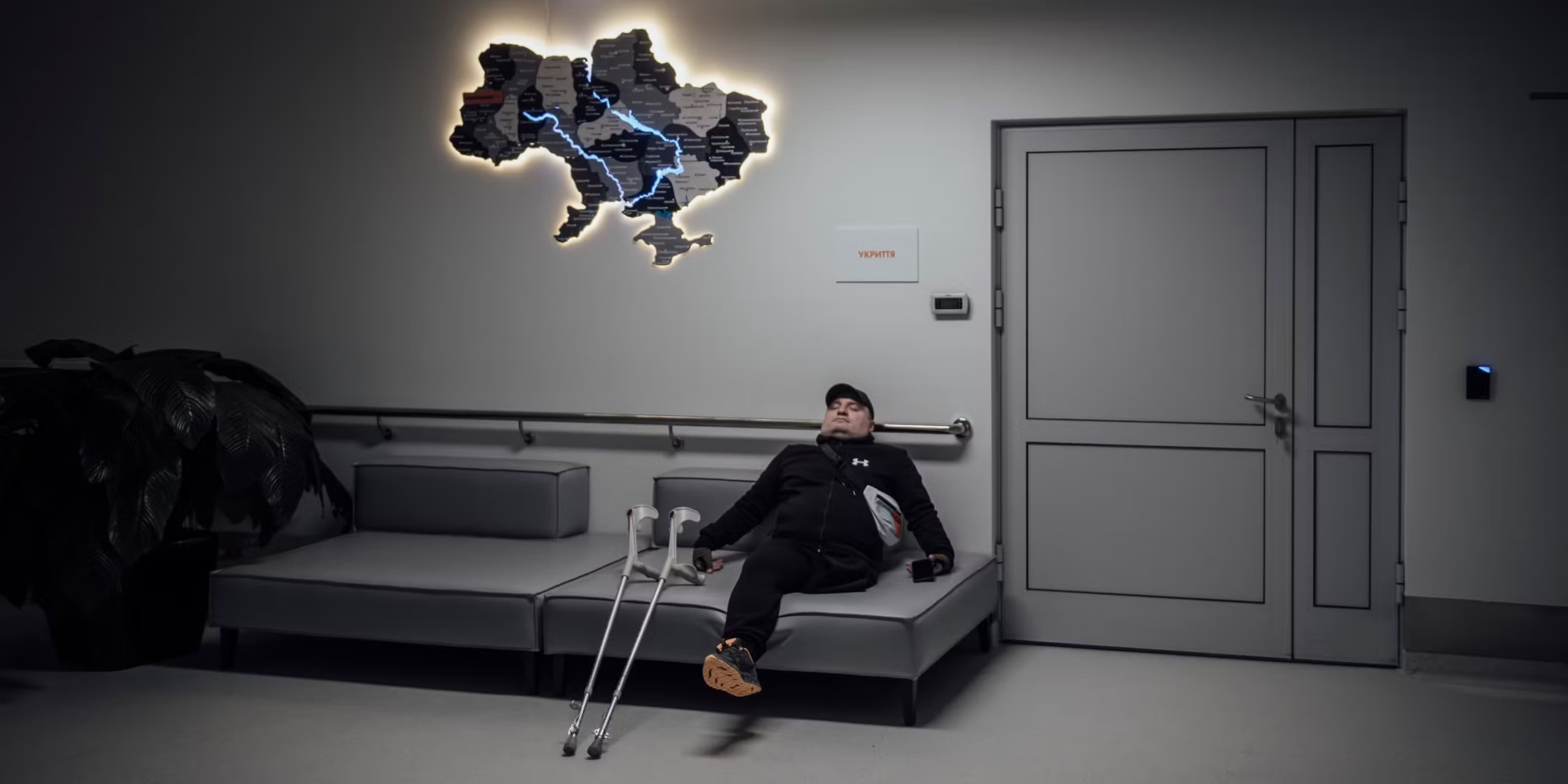
On May 16, he was in the bunker of a nine-story building, preparing to evacuate his unit’s position in the city, when a blast caused the wall to crumble and a concrete block to fall on him. He broke his hip in six places. Doctors told him they could not operate; he would instead have to lie flat in bed for two months, hoping it would heal on its own.
Yatsun, a former local official in his town near Kyiv, said he hopes to recover and return to his troops.
“Russians want to erase us,” he said. “So there is no other way than to fight back.”